


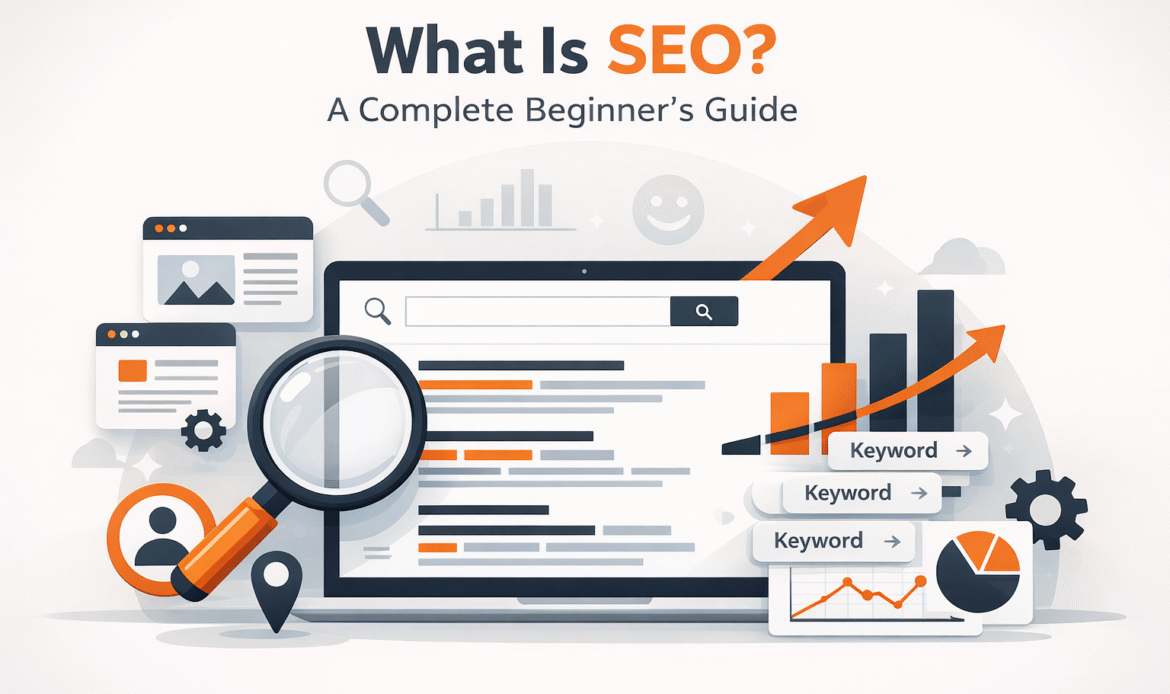
SEO, or Search Engine Optimization, refers to how websites become discoverable through search engines like Google. It’s not about gimmicks or shortcuts; instead, what is SEO really about is making sure your website appears when people actively search for your products or services.
In this guide, we’ll break down SEO in straightforward terms—what it involves, why it is essential, and how it functions.
What Is SEO, Exactly?
At its core, what is SEO can be defined as the process of improving your website so search engines can understand it, trust it, and rank it appropriately. When someone searches for a topic related to your business, SEO helps your website show up organically—without paying for ads.
Think of what is SEO as a bridge between your website and your audience.
If the bridge is strong, users can find you easily. If it’s weak, your website remains invisible.
Why Is SEO So Important?
To fully grasp what is SEO, you need to understand how search engines operate. They follow a structured process to discover, analyze, and rank websites.
SEO is beneficial because it:
- Generates free, continuous traffic
- Establishes credibility (people tend to trust Google’s top results)
- Operates long-term instead of ceasing when ads stop running
- Draws in individuals who are already interested in what you provide
How Search Engines Work and Rank Websites
Search engines follow several key steps to determine which sites show up in search results and their ranking order. Each of these steps is crucial for how your content is found and assessed.
1- Crawling the Web
Search engines utilize automated software, commonly referred to as bots or crawlers, to navigate the internet. These bots traverse from one page to another by following hyperlinks, searching for newly added content or updates to current pages. A well-organized and interconnected website allows crawlers to discover your pages more efficiently.
2- Indexing the Content
After crawling, the content is stored in a massive database. Pages that meet quality standards are eligible to appear in search results; this is a key part of what is SEO.
3- Understanding Search Intent
Search engines focus on matching results to user intent, not just keywords. This is why modern what is SEO strategies prioritize helpful content.
4- Ranking the Results
After interpreting the query, the search engine arranges relevant pages based on numerous factors. These encompass content quality, relevance, backlinks, page loading speed, mobile-friendliness, and overall user experience. Pages that offer the most useful and reliable answers receive higher rankings.
5- Showing the Best Results
In the end, the search engine presents the ranked pages on the search results page. The aim is to provide users with the most accurate answer as efficiently as possible. Websites that regularly deliver valuable content and an excellent user experience are more likely to sustain high rankings over time.
SEO aims to ensure your website is discoverable, easily understandable, and worthy of being showcased.
How SEO Works to Improve Search Rankings
Search engines assess various signals before ranking a page, including:
- Does the content align with what users are searching for?
- Is it useful and easy to read?
- Does the page load quickly?
- Is it optimized for mobile devices?
- Are there links from other reputable websites pointing to it?
- The more criteria your website meets, the higher your chances of achieving a better ranking.
The Core Types of SEO for Better Rankings
SEO encompasses multiple elements that work in concert.
On-Page SEO
This encompasses:
- Naturally using keywords
- Crafting clear headings
- Optimizing titles and meta descriptions
- Generating valuable, original content
- Linking among your pages
The better your website aligns with these factors, the stronger your SEO performance becomes proving once again what is SEO is about value, not tricks.
Off-Page SEO: What Others Communicate About You
- This relates to trust and authority:
- Backlinks from other sites
- Brand mentions
- Reviews and your online reputation
If reputable websites discuss you, search engines are more likely to place their trust in you as well.
Technical SEO: The Behind-the-Scenes Aspects
This area emphasizes performance:
- Rapid-loading pages
- Mobile-friendly layouts
- Secured website (HTTPS)
- Organized URLs and structures
Users might overlook technical SEO—but search engines certainly won’t.
Local SEO (For Businesses with a Physical Presence)
If you manage a local enterprise, local SEO assists you in appearing in searches such as “near me” or searches specific to your city.
Creating Content That Ranks Well
Effective SEO begins with high-quality content.
This entails:
- Writing primarily for people, not just for search engines
- Addressing real questions straightforwardly
- Steering clear of keyword stuffing
- Maintaining content that is valuable and authentic
- If your content assists the reader, search engines typically recognize and reward it.
How Long Does SEO Take?
- Minor improvements within the first 1–3 months
- Significant advancements in 3–6 months
- Robust outcomes after 6–12 months
SEO resembles nurturing a plant rather than flipping a switch.
SEO vs Paid Ads: Which Is More Effective?
SEO delivers long-term benefits.
Paid advertisements provide immediate visibility, but that stops as soon as you cease to pay.
The smartest strategy:
Utilize both together whenever feasible.
Common SEO Mistakes to Avoid
Many newcomers face challenges because they:
- Overload on keywords everywhere
- Neglect mobile users
- Release low-quality content
- Purchase unreliable backlinks
- Overlook technical improvements
Steering clear of these errors conserves your time and safeguards your rankings.
Is SEO Still Valuable in 2026?
Absolutely, more than ever before. As digital search continues to evolve with the rise of AI, voice assistants, and shifting user behavior, many businesses question whether SEO remains a worthwhile investment in 2026. With search engines delivering answers faster and competition increasing across all industries, understanding the role of SEO today is more important than ever. This introduction examines why SEO remains a vital pillar of digital marketing and how its value has evolved to meet the evolving demands of modern search experiences.
Search engines are increasingly focused on quality, relevance, and user experience. This means effective SEO is about following best practices rather than trying to manipulate the system.
Do You Need an SEO Agency?
While learning what is SEO is possible on your own, professional agencies help you scale faster and avoid costly mistakes—especially when competition is high.
You may require professional assistance if:
- Your traffic isn’t increasing
- You’re not ranking for important terms
- Your competitors are outperforming you
- Technical SEO feels daunting
Ready to Transform SEO Into Real Growth?
Understanding what SEO entails only goes so far. True results stem from a consistent strategy and effective execution.
At Markera Agency, we support businesses in enhancing their visibility, improving their Google rankings, and converting traffic into customers through clear strategies, solid technical SEO, and engaging content.
Request your SEO audit today. Let’s discover what may be hindering your website and how to resolve it.
Reach out to Markera Agency now and start converting searches into tangible outcomes